How AI is Creating the Cognitive Luminaire
28 Apr, 20265 MinutesThe traditional philosophy of lighting has always been reactive. The sensor detects motion, ...

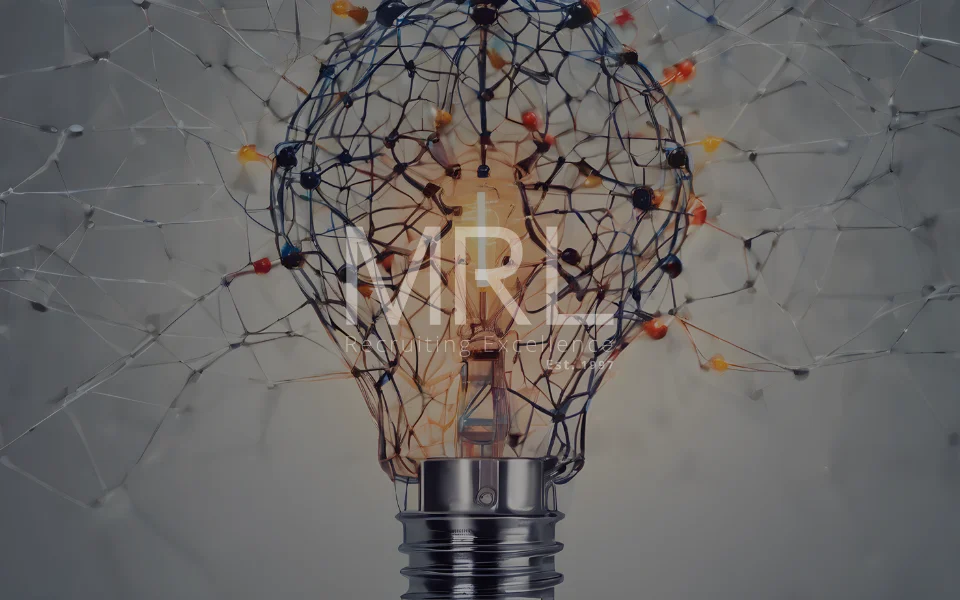
The traditional philosophy of lighting has always been reactive. The sensor detects motion, or a user flips a switch, and the environment responds. But the industry is undergoing a paradigm shift, moving away from reactive systems toward Cognitive Lighting. Environments that use Artificial Intelligence to anticipate human needs before they are explicitly expressed.
For MRL, this evolution is fundamentally altering the recruitment landscape. Whilst the demand for traditional optical engineers is still high, there is a need for "hybrid" specialists who can navigate the intersection of photonics, machine learning, and data science.
AI in Optical Design
The impact of AI begins long before a product reaches the end-user. In R&D, machine learning is revolutionising how we 'engineer the invisible'. Historically, designing complex optical systems or metasurfaces was a process of trial and error that could take months. Today, researchers are leveraging
Beyond design, AI is impacting precision manufacturing. In photonics,
Predictive Lighting
In commercial and residential spaces, the goal has shifted from "smart" to "predictive." While a smart light might turn on when you enter a room, a predictive system uses behavioural intelligence to understand why you are there.
By processing data from high-resolution sensors, AI can now distinguish between different types of activity. In a retail environment, for example,
Smart Cities and Predictive Maintenance
The scale of AI integration extends to our urban infrastructure, too. Modern "Adaptive Lighting" for smart cities uses AI to modulate street lighting intensity based on real-time pedestrian density and traffic flow. This not only reduces light pollution but also significantly lowers municipal energy expenditures.
Perhaps most critically for the bottom line is the rise of
This shift toward LaaS is fundamentally redefining the commercial relationship between manufacturers and end-users, moving from a one-time hardware transaction to a long-term, subscription-based partnership. Under this model, organisations no longer "own" their luminaires; instead, they pay for a guaranteed level of illumination and efficiency while the provider manages the entire lifecycle, from installation to AI-driven performance monitoring.
This approach is being pioneered by industry giants like
The New Talent Profile
As AI continues to weave itself into the fabric of the lighting and optics industry, the "perfect" candidate profile has changed. To lead in this space, firms must secure talent that understands both the physics of light and the logic of an algorithm.
At MRL, we specialise in identifying these rare, cross-pollinated professionals. Whether you are seeking a machine learning expert for your photonics R&D team or a software lead for a smart city project, our global network is positioned to find the innovators who are building the cognitive environments of tomorrow.